4 min read

A Certificate Is Not a Job: What Shrinking Teach-Abroad Field Tells US

A Certificate Is Not a Job: What Shrinking Teach-Abroad Field Tells US
7:59

The teach-abroad landscape lost a major name this year. CIEE — one of the largest and most established organizations in international education — announced it is retiring its Teach Abroad programs beginning in 2027, ending all new TEFL certification enrollments as of June 2026, and suspending its Teach in Spain volunteer program beginning in fall 2026. For a field that doesn't see big players exit very often, this is significant news.

CIEE offered something real — structured programs with actual support — and their exit narrows the field of organizations doing this work seriously. That's a huge loss and those of us remaining will miss CIEE's teach abroad work. But it also creates a moment worth reflection, because the departure of a provider that offered genuine programs raises an urgent, practical question for everyone now looking for an alternative: what, exactly, are you being sold?

The Distinction Most People Miss Until It's Too Late

Here is the thing the teach-abroad industry would often rather you not examine closely. There are, broadly, two very different kinds of companies operating under the same "teach English abroad" banner, and they are not the same purchase.

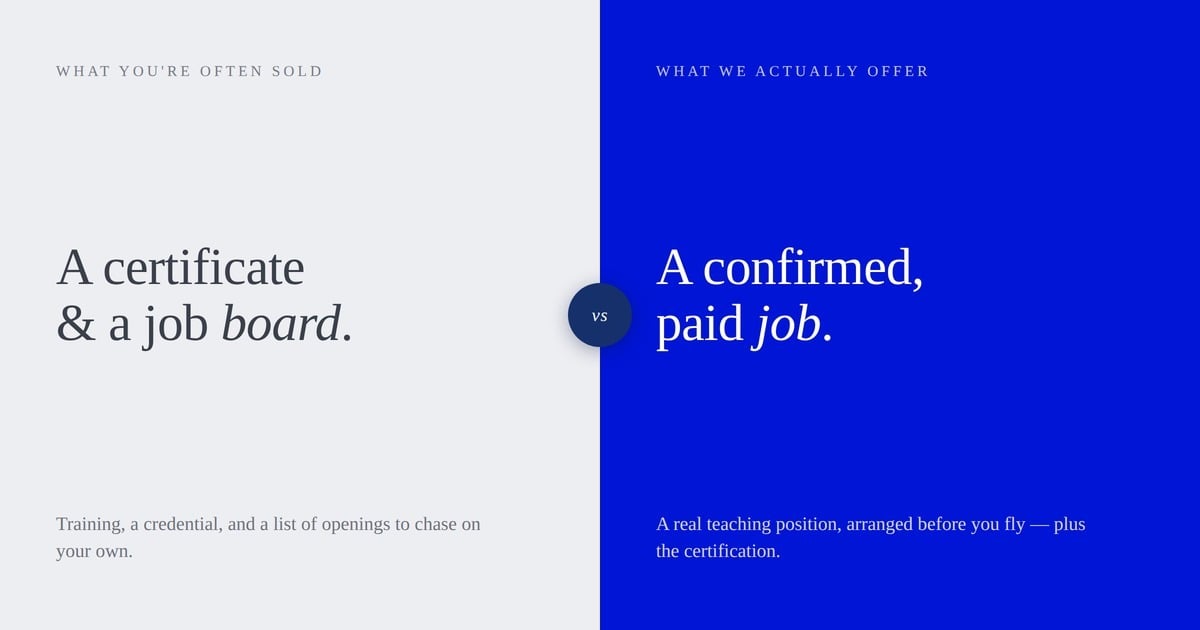
The first kind sells you a credential and a head start. You pay for a TEFL certification course, and in return you receive training, a certificate, and — this is the part to read carefully — job search guidance. Resources. A database of listings. Advice on how to apply. Lifetime access to a job board. These can be genuinely useful things. But notice what you do not receive: an actual job. You finish your course holding a certificate and a list of places that might hire you, and the work of landing a position — the applications, the interviews, the visa navigation, the risk — is yours to carry alone. After you've already paid hundreds of dollars for a TEFL certification and the hours to get it.

The second kind places you in an actual teaching position. Before you get on a plane, there is a confirmed, paid job waiting on the other end. The organization has arranged the placement, coordinated with the school, and secured the role. You depart because you have somewhere specific to go and something specific to do, with a paycheck attached.

Both models are legitimate. Both can be the right choice for the right person. But they are wildly different in what they guarantee, what they cost you in stress, and what happens if things don't work out — and they are frequently marketed in language vague enough that you can't easily tell which one you're looking at. "We'll help you teach abroad" can mean "we will place you in a job" or it can mean "we will sell you a course and point you toward a job board." Those are not the same sentence.

The One Question That Cuts Through It

You do not need to become an expert in the teach-abroad industry to protect yourself. You need to ask one question of any program you're considering:

When I finish, do I have a job — or do I have a list of jobs to apply for?

Everything else is downstream of that. If the honest answer is "you'll have our lifetime job search support and access to our listings," you are buying the first model — a certification with guidance. That may be exactly what you want, and if so, buy it with clear eyes. But if what you actually want is to step off a plane into a confirmed teaching role, you need the second model, and you need to confirm it in plain language before you pay.

A few follow-ups that flush out the truth quickly:

  • Who signs my employment contract, and when do I see it? A real placement means a real contract, ideally before you depart.
  • Is the job guaranteed, or is it placement "assistance"? "Assistance" is a soft word. Ask them to make it hard.
  • If I don't find a position, what happens? With a genuine placement model, that scenario doesn't exist — the job is arranged before you go.
  • Am I paying for a course, a placement, or both — and which one is the actual product? Some companies sell certification and describe the free job board as though it were a placement service.

Why This Matters More Right Now

When an organization like CIEE leaves the teach abroad field, the people who would have enrolled with them don't stop wanting to teach abroad. They start looking for somewhere else to go — often quickly, often in the summer scramble before a fall start. That urgency is exactly when it's easiest to sign up for something without reading it closely, and to mistake "we'll help you look for a job" for "we'll give you a job."

So if you're in that position now — reconsidering your plans because a provider you were counting on is winding down — treat it as a chance to buy more carefully than you might have the first time. Ask the one question. Insist on a plain answer.

At The Cultural Exchange Project, we operate on the second model, without hedging: our teachers have a guaranteed, paid teaching placement confirmed before they leave home. Not a certificate and a job board — an actual job, arranged in advance, in one of the countries where we place. We also provide the TEFL certification you'll need, so the training and the position come from the same place, accountable to the same outcome. That's the distinction this whole post is about, and it's the one we'd want anyone to hold any program to, including ours.

The field is getting smaller. That makes it more important, not less, to know what you're actually buying.

Frequently Asked Questions

What did CIEE announce about its teach-abroad programs?

CIEE announced it is retiring its Teach Abroad programs beginning in 2027, ending all new TEFL certification enrollments as of June 2026, and suspending its Teach in Spain volunteer program beginning in fall 2026. CIEE has stated it remains committed to other international exchange and study-abroad work.

Does a TEFL certification guarantee me a teaching job abroad?

No. A TEFL certification qualifies you to teach, but on its own it does not guarantee a position. Many certification providers offer "job search guidance" or access to job listings, which is help finding work — not a confirmed job. To have a guaranteed placement, you need a program that arranges an actual teaching position before you depart.

What's the difference between job placement and job assistance?

Job placement means the organization arranges a confirmed teaching position for you, typically with a contract in place before you travel. Job assistance means the organization helps you search — through advice, resources, or listings — but you are responsible for landing the job yourself. The words sound similar but describe very different levels of certainty.

What questions should I ask before paying for a teach-abroad program?

Ask whether you'll finish with an actual job or a list of jobs to apply for; who signs your employment contract and when; whether placement is guaranteed or merely "assisted"; what happens if you don't find a position; and whether you're paying for a course, a placement, or both. Clear answers to these reveal exactly what you're buying.

Does The Cultural Exchange Project guarantee a teaching placement?

Yes. CEP places teachers in guaranteed, paid teaching positions that are confirmed before departure, and also provides the required TEFL certification. This means the training and the job come from the same organization, rather than leaving you to find employment on your own after a course.


The Cultural Exchange Project is a 501(c)(3) nonprofit that has placed native English speakers in paid teaching positions abroad for decades. Programs in Thailand, Japan, South Korea, Costa Rica, Cambodia, Spain, and Vietnam.

CIEE Retired Teach Abroad and TEFL — Here's What That Means for You

1 min read

CIEE Retired Teach Abroad and TEFL — Here's What That Means for You

CIEE, one of the oldest names in international exchange, is winding down its Teach Abroad and TEFL certification programs. If you were planning to...

Read More
Job Hunting? Enhance Your Resume with TEFL PLUS and a Job Overseas

1 min read

Job Hunting? Enhance Your Resume with TEFL PLUS and a Job Overseas

The job market for recent graduates has never been more challenging. According to a recent Fortune article, job postings have fallen more than 16%...

Read More
Is Your Degree a Decoration?

1 min read

Is Your Degree a Decoration?

The brutal truth about today's job market and the strategic "secret weapon" you didn't know you had. Hey Grads! Feeling the Post-College Career...

Read More
Why a TEFL Certification Is Your Golden Passport to the World

1 min read

Why a TEFL Certification Is Your Golden Passport to the World

Imagine packing your bags, hopping on a plane, and landing in a country you’ve always dreamed of. Picture yourself strolling through rice fields in...

Read More
Thailand Visa Check: Current Non-Immigrant B Requirements for Teachers

1 min read

Thailand Visa Check: Current Non-Immigrant B Requirements for Teachers

Current as of July 2026. Thai visa and work-permit rules change periodically — always confirm the latest requirements with your placement...

Read More
Why Autumn Is the Best Time to Plan Your Teach Abroad Adventure

1 min read

Why Autumn Is the Best Time to Plan Your Teach Abroad Adventure

As the air cools and the leaves start to turn, there’s something magical about autumn — a sense of change, of endings and new beginnings. While many...

Read More