4 min read

CIEE Retired Teach Abroad and TEFL — Here's What That Means for You

CIEE Retired Teach Abroad and TEFL — Here's What That Means for You
8:20

CIEE, one of the oldest names in international exchange, is winding down its Teach Abroad and TEFL certification programs. If you were planning to teach English abroad through CIEE — or were weighing it as an option — here's what's actually changing, what it means for your plans, and how to choose a program that will still be standing when you're ready to go.

If you've been researching how to teach English abroad, you've almost certainly come across CIEE. So this news matters to anyone in the middle of that decision.

CIEE has announced it is retiring its Teach Abroad and TEFL certification programs. We want to lay out exactly what's changing, in plain terms — and then talk about what to look for in an alternative, because that's the question this actually leaves you with.

What CIEE announced

According to CIEE's own website, the organization is making the following changes:

  • Teach Abroad programs will be retired beginning in 2027.
  • New TEFL certification enrollments are ending beginning in June 2026.
  • The Teach in Spain Volunteer program will be suspended beginning in Fall 2026.

CIEE attributes the decision to a changing business environment. Importantly, this is the retirement of one program line — not the organization. CIEE has stated it remains committed to its broader mission of promoting intercultural understanding through international exchange and study abroad, which it has pursued since 1947.

We'll say this plainly: CIEE has been a serious, mission-driven nonprofit in this field for nearly eight decades, and its teachers have had good experiences through its programs. The end of this program line is genuinely a loss for the teach-abroad world. Our aim here isn't to dance on anyone's exit — it's to help the people now left looking for somewhere else to go. On several occasions, we have met with CIEE to learn more about teaching English abroad.

If you were planning to go through CIEE

Depending on where you are in the process, here's what this likely means:

If you haven't enrolled yet, the TEFL certification door is closing first, in June 2026, with Teach Abroad placements following in 2027. If you were planning to start either, you'll now need an alternative provider.

If you're already enrolled or placed: Direct questions about your specific program status to CIEE via their published contacts. We can't speak to the details of their teach-out plans, and you deserve precise answers from the source.

If you were considering Teach in Spain specifically: That program is being suspended beginning in Fall 2026, so it's worth confirming timelines directly before counting on it.

Whatever your situation, the practical upshot is the same: if teaching abroad is still your goal, the search for a program is back on. So let's make that search a good one.

How to choose a teach-abroad or TEFL program that lasts

Not all programs are built the same, and the differences matter more than the marketing makes them sound. Here's what actually separates a program worth your money from one that will leave you stranded.

1. Accreditation that means something. A TEFL certificate is only as good as the body standing behind it. Look for internationally recognized accreditation and a course of at least 120 hours — that's the threshold most reputable employers and visa authorities expect. A 40- or 60-hour "certificate" from an unaccredited site can quietly disqualify you from the jobs you actually want.

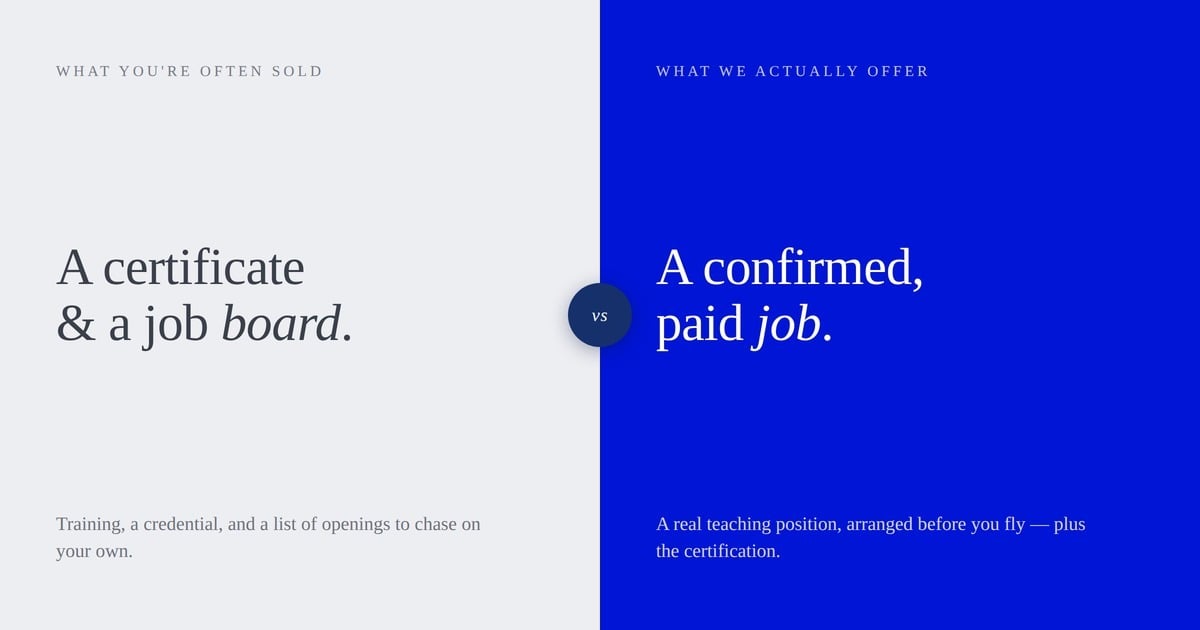
2. "Guaranteed placement" — not "placement assistance." This is the single most important distinction, and it's easy to miss. Many programs promise placement assistance — they'll help you look, share leads and polish your resume. That is not the same as a guaranteed placement, where you don't board the plane until you have a confirmed, paid teaching position waiting for you. Read the words carefully. "We'll help you find a job" and "you have a job" are very different promises. We also do that. For graduates who are unable to pass an interview, travel to the job site when the opening exists, or get their diploma legalized, we certainly can help you and point you in the right direction. For those who meet all of the criteria and pass the interviews and demo classes, we do guarantee a teaching job.

3. Paid positions, stated clearly. A real teach-abroad program should be able to tell you the salary, the benefits, and what your money actually covers before you commit. Vague language about "opportunities" is a red flag. Concrete numbers are a green one.

4. Real, in-country support. Pre-departure guidance, help with the document and visa process, and an actual human to call once you're abroad. The paperwork for countries like South Korea is genuinely demanding; doing it alone is where most people stumble.

5. An organization that will be there when you arrive. This is the lesson of this very announcement. Programs change. Choose one with a stable model, a real track record, and a reason to still be operating when your contract begins — and ideally when you want to renew.

Where The Cultural Exchange Project fits

We built our programs around exactly these criteria, so we'll be direct about how we measure up:

  • TEFL Plus is our 120-hour, internationally accredited TEFL certification — lifetime, online, and valid for any country program.
  • We offer guaranteed paid placements, not placement assistance. You have a confirmed teaching position before you depart.
  • Our placements are paid, with salaries and benefits laid out plainly on each country's page — Thailand, Vietnam, South Korea, Japan, Cambodia, Costa Rica, and Spain.
  • We provide full document and visa support, as well as in-country assistance, because we know that's where good intentions go to die without help.
  • And we're a 501(c)(3) nonprofit that has been placing teachers abroad for decades, with the relationships and the stability to keep doing it.

If CIEE's exit has sent you looking, we'd genuinely welcome a conversation — no pressure, just a straight answer to whatever you're trying to figure out.

Explore where you can teach abroad → Or learn about TEFL Plus certification →


Frequently Asked Questions

Is CIEE shutting down? No. CIEE is retiring its Teach Abroad and TEFL certification program line, not closing as an organization. CIEE remains committed to its broader mission of international exchange and study abroad, which it has pursued since 1947.

When are CIEE's Teach Abroad and TEFL programs ending? According to CIEE, new TEFL certification enrollments will end beginning in June 2026, Teach Abroad programs will be retired beginning in 2027, and the Teach in Spain Volunteer program will be suspended beginning in Fall 2026. Anyone currently enrolled should contact CIEE directly for details on their specific program.

What should I look for in a teach-abroad program now? Prioritize internationally recognized TEFL accreditation, a course of at least 120 hours, and — most importantly — guaranteed placement rather than "placement assistance." Also, confirm that positions are paid with clearly stated salaries, that document and visa support are provided, and that the organization has a stable track record.

What's the difference between guaranteed placement and placement assistance? Placement assistance means a program helps you search for a job — sharing leads and reviewing your application — but does not promise one. Guaranteed placement means you have a confirmed, paid teaching position before you depart. The distinction matters significantly when you're committing time and money to going abroad.

Does The Cultural Exchange Project offer guaranteed teaching placements? Yes. The Cultural Exchange Project provides guaranteed paid teaching placements — a confirmed position before departure — across Thailand, Vietnam, South Korea, Japan, Cambodia, Costa Rica, and Spain, along with its 120-hour internationally accredited TEFL Plus certification, full visa and document support, and in-country assistance.


The Cultural Exchange Project is a 501(c)(3) nonprofit that has placed native English speakers in paid teaching positions abroad for decades. Programs in Thailand, Japan, South Korea, Costa Rica, Cambodia, Spain, and Vietnam.

What to Know Before You Get A Guaranteed Teaching Job Abroad

1 min read

What to Know Before You Get A Guaranteed Teaching Job Abroad

If you are tired of sending resumes without hearing back, a paid teach abroad program with guaranteed placement may offer a more direct path to...

Read More
Ever Heard Of Voluntourism? Stick A Thousand Needles In My Eye

1 min read

Ever Heard Of Voluntourism? Stick A Thousand Needles In My Eye

Where can I go to volunteer abroad?Who offers voluntourism programs?What projects are available?What will it cost?Are there any pitfalls?

Read More
Internship Abroad in Chile: Kyle's Adventure

1 min read

Internship Abroad in Chile: Kyle's Adventure

I was fortunate enough to be able to study abroad in Seville, Spain when I was an undergrad at the University of Wisconsin. My time spent in Spain,...

Read More
Some Real Ideas To

1 min read

Some Real Ideas To "Help Me Teach" Abroad

Guest Post byBetsy BruneauHelp Me Teach DeskGeoVisions

Read More
Beyond Teaching in Thailand: A Life Changing Experience

1 min read

Beyond Teaching in Thailand: A Life Changing Experience

When I made the decision to move to Thailand through the GeoVisions Teach Abroad program, I knew it was inevitable that I was going to be pushed out...

Read More
Online Reviews - A Great NY Times Piece Last Sunday

1 min read

Online Reviews - A Great NY Times Piece Last Sunday

Last Sunday (August 26, 2012) the NY Times ran a fantastic article on the FRONT PAGE of the Business section entitled, "The Best Reviews Money Can...

Read More