1 min read
How to Choose the Perfect Country to Teach English Abroad
Deciding to teach English abroad is thrilling — the world opens up with endless possibilities. But with so many destinations calling your name, how...
5 min read
Randy LeGrant
:
Updated on July 27, 2026
All figures reflect our own program data as of July 2026 and are subject to change. Salaries in local currency fluctuate against the dollar. Confirm current figures with us before making financial decisions.
Almost every "teach abroad salary" article you'll find ranks countries by monthly pay. It's the wrong number.
Monthly salary tells you what lands in your account. It tells you nothing about what's left after rent, tax, and the cost of a normal life — and that gap between the two is enormous. In our own seven programs, the country with the highest salary is not the country where teachers save the most. It isn't even close.
We place teachers in Thailand, Japan, South Korea, Costa Rica, Cambodia, Spain, and Vietnam. Here is what each actually pays, what it actually costs, and what teachers realistically keep.
| Country | Monthly salary | Typical rent | Income tax | Estimated monthly savings |
|---|---|---|---|---|
| South Korea | $1,600–$1,900 | $0 — housing provided | 4–7% (0% for US citizens, first 2 years) | $400–$1,000+ |
| Vietnam | $1,400–$1,600 | $200–$500 | 5–20% | $300–$800 |
| Japan | ¥215,000–¥250,000 (≈$1,400–$1,900) | $350–$550 | 10–15% + ~15% social insurance | $150–$400 |
| Thailand | $1,400 (฿45,000) | $150–$300 | 0–10% | $200–$400 |
| Cambodia | $800–$1,500 (no degree) · $1,000–$1,600 (degree) | $200–$400 | 0–10% | $300–$500 |
| Costa Rica | $700–$1,000 (no degree) · $700–$1,800 (degree) | $350–$800 | ~2% | Varies |
| Spain | €700–€1,400 (ramps up over months) | €300–€800 | ~2% | €0–€300 |
Read that table twice, because the interesting part isn't in the first column.
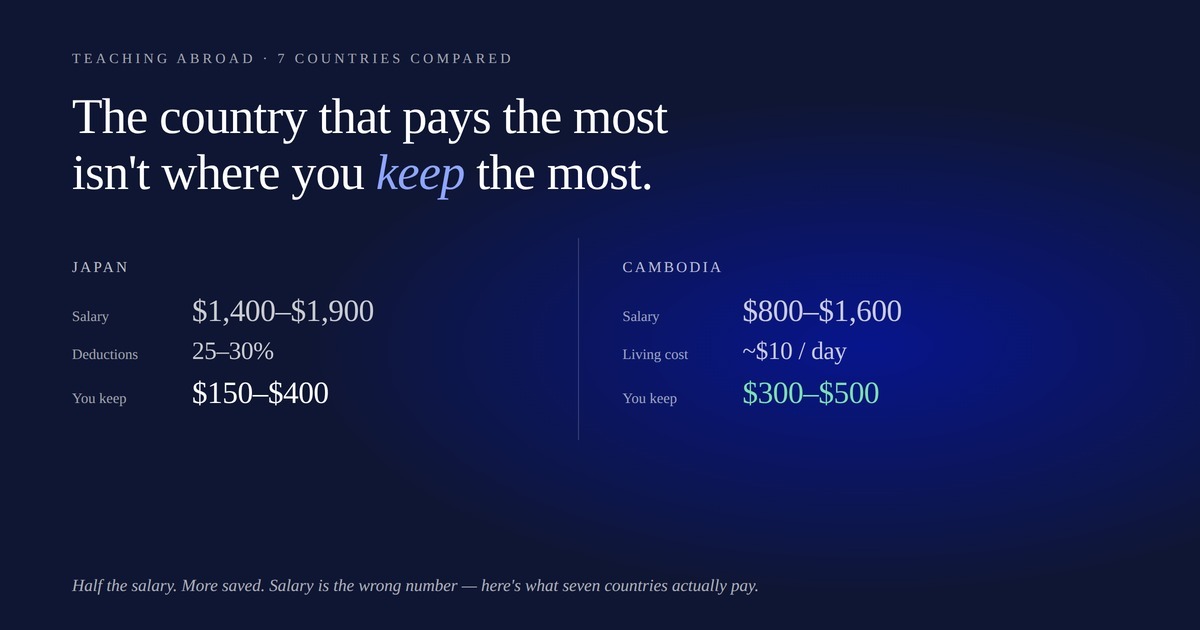
Japan pays among the highest headline salaries of our seven countries. It also produces some of the lowest savings — an estimated $150 to $400 a month.
The reason is arithmetic, not disappointment. Japanese deductions in your first year run roughly 25–30% once you combine income tax (10–15%) with social insurance for pension and health (around 15%). Add rent of $350–$550, and a strong salary compresses fast.
Now look at Cambodia. A teacher there might earn half what a teacher in Japan earns — and save more, $300 to $500 a month, because living costs run around $10 a day and rent starts near $200. The salary is smaller. The gap between what comes in and what goes out is wider.
This is the single most useful thing to understand about teaching abroad: you are not optimizing for salary. You are optimizing for the distance between salary and cost of living.
If you rank our programs by what teachers actually keep, South Korea comes first, and it isn't particularly close: $400 to $1,000 or more per month.
Korea's salary is strong but not dramatically higher than Japan's. What separates it is what Korea removes from the expense side. Housing is provided — a semi-furnished apartment, not a stipend — which eliminates the single largest monthly cost a young person faces anywhere in the world. Korean income tax for teachers runs 4–7%, and US citizens can claim an exemption reducing it to zero for their first two years with a Residency Certificate. Add a flight reimbursement of up to $1,000 and a severance payment of roughly one month's salary on completing the contract, and the package pulls decisively ahead.
Korea is the answer for anyone whose primary goal is to come home with money.
Two countries produce a number that makes people check it twice: Costa Rica and Spain both tax teachers at around 2%.
In Costa Rica, that 2% sits alongside salaries of $700–$1,000 without a degree, or up to $1,800 for degree holders, in a country where North Americans don't need a degree to qualify at all. In Spain, the ~2% applies to the internship-style contracts teachers work under on the education visa.
Low tax isn't the whole picture — Costa Rican rent runs $350–$800, higher than Southeast Asia — but for anyone comparing take-home rather than gross, a 2% rate is worth understanding.
Spain is the outlier in this table, and we'd rather say so plainly than bury it.
Teaching hours in Spain ramp up rather than starting full. A typical trajectory runs roughly €528 in month one, €792 in month two, €1,056 in month three, building toward a potential €1,200–€1,400 once you're placed across multiple schools. Savings potential is €0–€300 a month. We ask teachers to arrive with $3,000–$4,000 in cash to cover the ramp-up period.
By the numbers, Korea and Thailand will pay you more. We say this on our own Spain program page.
So why does anyone choose it? Because Spain isn't bought for the salary. It's bought for a legal, structured way to live in Barcelona for a year — an education visa, 240 hours of Spanish classes included, and the right to work legally while you're there. People choose Spain because they want Barcelona, specifically, and the money is the price of admission rather than the point. That's a legitimate reason. It's just a different question than "where will I save most?"
Three different people should read this table three different ways.
If your goal is to save money: South Korea, then Vietnam. Free housing and near-zero tax in Korea; a strong salary-to-cost gap in Vietnam at $300–$800 a month.
If your goal is accessibility: Cambodia and Costa Rica. Cambodia requires no degree at all; Costa Rica waives the degree requirement for US and Canadian applicants. Both still produce real savings.
If your goal is a specific life somewhere: Spain for Barcelona, Japan for Japan. Accept a smaller financial return in exchange for the place itself, and go in with your eyes open about the numbers.
There is no single best-paying country to teach in. There is only the country whose numbers fit what you're trying to do — and now you have all seven.
Compare all seven programs and talk to us about the right fit →
By headline salary, South Korea and Japan are highest among our seven programs, at roughly $1,400 to $1,900 per month. But salary alone is misleading. Japan produces estimated savings of only $150 to $400 monthly after roughly 25–30% in deductions and rent, while South Korea produces $400 to $1,000 or more because housing is provided and US citizens can claim a two-year tax exemption.
South Korea, by a clear margin — an estimated $400 to $1,000 or more per month. Free provided housing removes the largest single expense, income tax runs 4–7% with a two-year exemption available to US citizens, and the package includes flight reimbursement up to $1,000 plus a severance payment of about one month's salary on contract completion. Vietnam is second at $300 to $800 monthly.
It varies widely. Costa Rica and Spain are lowest at approximately 2%. Thailand and Cambodia run 0–10%. South Korea is 4–7%, with US citizens able to claim a two-year exemption to zero. Vietnam runs 5–20% depending on residency status. Japan is highest in effective terms: 10–15% income tax plus roughly 15% social insurance, totaling 25–30% of gross in your first year.
Yes, in some countries. Cambodia does not require a bachelor's degree, and Costa Rica waives the requirement for US and Canadian applicants. Spain also requires no degree. Thailand, Japan, South Korea, and Vietnam all require a bachelor's degree, generally because the work visa itself requires one.
Spain's teaching work is structured around an education visa and internship-style contracts, with hours ramping up over the first months rather than starting full-time. Earnings typically build from around €528 in month one toward a potential €1,200–€1,400, with savings potential of €0–€300 monthly. Teachers choose Spain for legal residence in Barcelona and included Spanish language study rather than for maximum earnings.
The Cultural Exchange Project is a 501(c)(3) nonprofit that has placed native English speakers in paid teaching positions abroad for decades. Programs in Thailand, Japan, South Korea, Costa Rica, Cambodia, Spain, and Vietnam.
Randy LeGrant, CEP's Executive Director, writes these blog posts. If you like his writing, he also writes The Crossing — a weekly letter drawn from fifty years of watching people change their lives and their location. One story, one step, one question. Three minutes, every Friday. Subscribe free here.
1 min read
Deciding to teach English abroad is thrilling — the world opens up with endless possibilities. But with so many destinations calling your name, how...
1 min read
You walked at graduation a few weeks ago. Right now, this month, you have a timing advantage that won't come back: June applicants get first pick of...
1 min read
I wanted to travel. I wanted to experience a different country and culture. I wanted meaningful work and to engage in a new language. And I wanted to...
1 min read
When I checked my email first thing this morning, I noticed an article from Education Week entitled How COVID-19 Is Hurting Teacher Diversity. I...
1 min read
Homestay abroad What if you’re wanting to travel abroad right now? How comfortable do you feel traveling overseas when you see news headlines like...
1 min read
The Fourth of July is the one American holiday that doesn't travel well. Thanksgiving you can explain. Halloween has gone global. But the Fourth —...