5 min read

Can You Teach Abroad Without Wrecking Your Student Loans?

Can You Teach Abroad Without Wrecking Your Student Loans?
9:49

This article is general information, not financial or tax advice. Federal student loan rules changed substantially in 2026 and continue to evolve. Always confirm your specific situation with your loan servicer and a qualified tax professional, and rely on official guidance at StudentAid.gov before making decisions.

It's the question that stops a lot of recent graduates before they even let themselves consider teaching abroad: I have student loans. Can I really leave the country? The fear is that going overseas means defaulting, tanking your credit, or somehow making the debt worse.

Here's the short, honest answer: teaching abroad does not wreck your student loans — as long as you handle them correctly before you go. In fact, for many teachers, monthly payments actually drop while they're overseas. But there are real rules to understand, and 2026 changed several of them. This is what you need to know.

First, the Myth to Kill

Let's clear up the most dangerous misconception right away: moving abroad does not pause, reduce, or erase your federal student loans on its own.

Your loans don't know or care what country you're in. The balance stays. Interest behaves exactly as it would at home. And if you simply stop paying because you've left the country, your loans will eventually go into default — and enforcement mechanisms like credit reporting and seizure of tax refunds still reach you overseas. The debt is legally yours whether you're in Denver or Da Nang.

So the goal is not to escape your loans by leaving. The goal is to manage them properly from abroad — which is entirely doable, and often to your advantage.

Why Your Payment Might Actually Drop

Here's the part that surprises people, and it's genuinely good news.

Federal income-driven repayment (IDR) plans calculate your monthly payment based on your income — specifically your adjusted gross income, or AGI. And U.S. citizens working abroad have access to the Foreign Earned Income Exclusion (FEIE), which allows you to exclude a large portion of foreign-earned income from your U.S. taxable income. For 2026, that exclusion is up to $132,900.

Now consider what a teaching-abroad salary actually looks like. Most placements pay somewhere in the range of $1,400 to $1,900 a month — well under that exclusion cap. That means that, for most teachers abroad, essentially all of your foreign teaching income can be excluded, dropping your AGI for U.S. tax purposes to a very low level, potentially to zero.

And on an income-driven plan, a very low AGI can mean a very low monthly payment — in some cases as little as $0 per month — while your loan remains completely current and in good standing. Those low-or-zero payments still count as qualifying payments toward eventual loan forgiveness under IDR program rules.

This isn't a loophole you have to engineer. Because teaching salaries sit so far below the exclusion cap, the effect is close to automatic for most overseas teachers — provided you're enrolled in the right kind of plan, and you keep up with the paperwork.

The Paperwork That Makes It Work

The low payment is not magic, and it is not automatic. Two things have to be true:

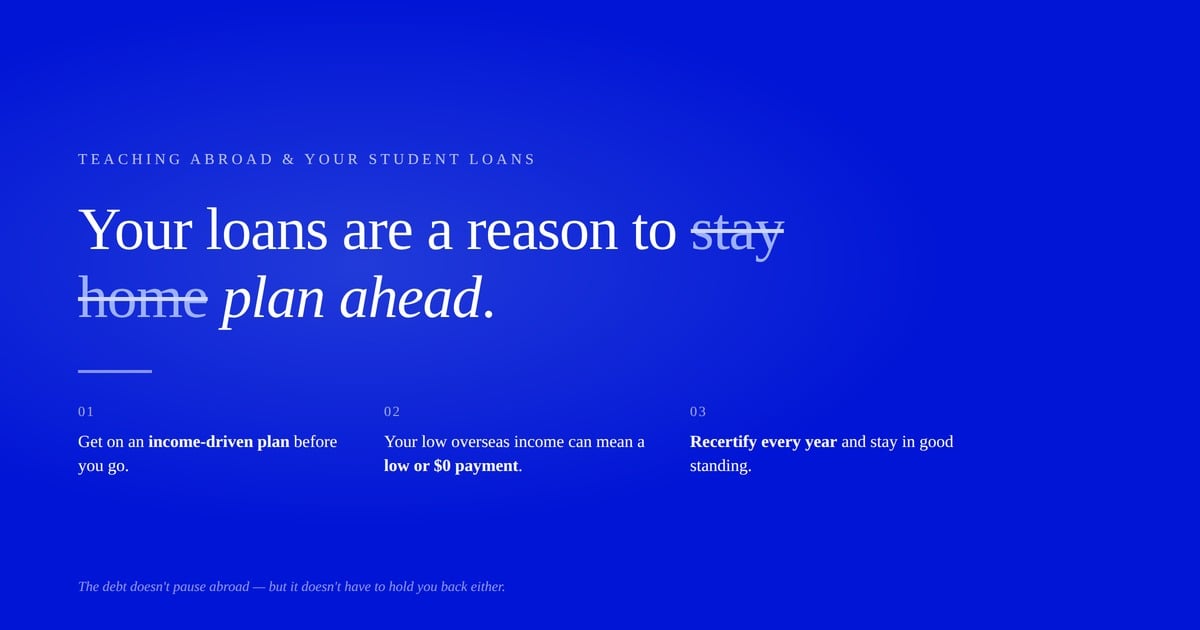
You must be enrolled in an income-driven repayment plan. The payment reduction is due to the income-based formula. If you're on a standard fixed-payment plan, your payment is based on your balance, not your income, and living abroad won't lower it. So step one, before you leave, is confirming you're on an income-driven plan.

You must recertify your income every year. IDR plans require annual recertification — you update your servicer with your current income and family size. This is the step that keeps your payment aligned with your (low) overseas AGI. Miss the recertification deadline and your payment can jump back up. Set a calendar reminder; it's the single most important administrative task while you're abroad.

A practical tip from people who've done it: keep a U.S. bank account open before you go, so you can maintain autopay in dollars. Paying from a foreign account, in a foreign currency, is a recurring headache you can avoid by setting it up in advance.

What Changed in 2026

You may have heard that student loans went through major changes recently. They did, and it's worth knowing where things stand, because it affects which plan you're on.

The SAVE plan was eliminated — a federal court vacated it in March 2026, and borrowers are being moved off it. For anyone whose first federal loan was disbursed on or after July 1, 2026, the menu of repayment plans narrowed sharply: the two options are now the Repayment Assistance Plan (RAP) — an income-driven plan setting payments at roughly 1% to 10% of income, with a $10 minimum, and forgiveness after 30 years — and a Tiered Standard fixed-payment plan.

If your loans were disbursed before July 1, 2026, you generally retain access to the older income-driven plans, including Income-Based Repayment (IBR), at least for now. The key takeaway for anyone planning to teach abroad: the income-driven approach that makes a low overseas payment possible still exists — but the specific plan you'll use depends on when you borrowed, and it's worth confirming exactly which one applies to you before you go.

Two Honest Cautions

Because this is your financial life, two things you should know rather than discover later:

Forgiveness at the end of an IDR plan is now taxable again. A pandemic-era rule that made forgiven balances tax-free expired at the end of 2025. Starting in 2026, a balance forgiven after your 20-to-30-year repayment term is treated as taxable income in the year it's forgiven. For a recent grad weighing a year or two abroad, this is a distant consideration, not an immediate one — but it's real, and worth filing away. (Public Service Loan Forgiveness, separately, remains tax-free.)

Public Service Loan Forgiveness generally won't count your overseas teaching. PSLF requires employment with a qualifying U.S.-based employer. Teaching at a foreign school typically doesn't qualify, so if you're pursuing PSLF, understand that a stint abroad usually pauses your progress toward it rather than adding to it. If PSLF is part of your plan, talk to your servicer specifically about how time abroad fits.

The Bottom Line

Teaching abroad with student loans isn't reckless, and it isn't a way to run from what you owe. Handled properly, it's simply a different — and often cheaper — way to stay current on your loans while you build a life and a career overseas. Get on an income-driven plan, understand how your low overseas income affects your payment, recertify every year, and keep the debt in good standing.

Your loans are a reason to plan carefully. They are not a reason to stay home.

Confirm your repayment plan details at StudentAid.gov before you go →

Frequently Asked Questions

Do I have to keep paying my student loans if I move abroad?

Yes. Moving abroad does not pause, reduce, or cancel your federal student loans. The balance and interest continue exactly as they would in the U.S., and if you stop paying, your loans can default — with enforcement such as credit reporting and tax refund seizure still applying while you're overseas. The debt remains legally yours regardless of where you live.

Can teaching abroad lower my student loan payments?

It can, if you're on an income-driven repayment plan. These plans base your payment on your adjusted gross income, and the Foreign Earned Income Exclusion lets U.S. citizens exclude up to $132,900 (in 2026) of foreign earnings from taxable income. Because teaching salaries are typically well under that cap, many teachers abroad see their calculated payment drop significantly — sometimes to as little as $0 — while the loan stays current.

Does living abroad cancel or forgive my student loans?

No. There is no mechanism by which living overseas forgives federal student loans. Low or $0 payments under an income-driven plan can still count toward the plan's eventual forgiveness timeline (20 to 30 years depending on the plan), but simply being abroad does not erase the debt. Anyone who stops paying rather than enrolling in a proper plan risks default.

What student loan changes happened in 2026?

The SAVE plan was eliminated in 2026, and repayment options narrowed for new borrowers. If your first federal loan was disbursed on or after July 1, 2026, your only options are the Repayment Assistance Plan (RAP) and a Tiered Standard plan. Borrowers with loans from before that date generally retain access to older income-driven plans such as IBR. Confirm which applies to you at StudentAid.gov.

Do I still qualify for Public Service Loan Forgiveness while teaching abroad?

Generally no. PSLF requires employment with a qualifying U.S.-based employer, and teaching at a foreign school typically does not qualify. Time spent teaching overseas usually does not count toward PSLF and may pause your progress. If you are pursuing PSLF, speak with your loan servicer about how a period abroad affects your specific situation before you go.


The Cultural Exchange Project is a 501(c)(3) nonprofit that has placed native English speakers in paid teaching positions abroad for decades. Programs in Thailand, Japan, South Korea, Costa Rica, Cambodia, Spain, and Vietnam.


Thailand's New Visa Rules. Here's Why CEP Teachers Don't Need to Worry

1 min read

Thailand's New Visa Rules. Here's Why CEP Teachers Don't Need to Worry

Thailand is cutting its visa-free stay from 60 days to 30 and cracking down on border runs. If you're planning to teach English in Thailand, here's...


Read More
New Grads: Why June Is the Month to Lock In a Fall Teach-Abroad Job

1 min read

New Grads: Why June Is the Month to Lock In a Fall Teach-Abroad Job

You walked at graduation a few weeks ago. Right now, this month, you have a timing advantage that won't come back: June applicants get first pick of...

Read More
Teaching Abroad: For the Young & Young At Heart

1 min read

Teaching Abroad: For the Young & Young At Heart

“You should travel abroad right after graduating from college,” is a common phrase I hear from friends, family and professors. People constantly tell...

Read More
Job Hunting? Enhance Your Resume with TEFL PLUS and a Job Overseas

1 min read

Job Hunting? Enhance Your Resume with TEFL PLUS and a Job Overseas

The job market for recent graduates has never been more challenging. According to a recent Fortune article, job postings have fallen more than 16%...

Read More
Become a paid English teacher in Costa Rica

1 min read

Become a paid English teacher in Costa Rica

Discover how you can teach English in Costa Rica and get paid for it!

Read More