

4 min read

Veterans Day: Teachers Who Served, Now Teaching Abroad

Veterans Day: Teachers Who Served, Now Teaching Abroad
7:14

Current as of November 2026. Salary figures come from CEP's live program pages. Confirm the details with our team before you commit money or travel.

You've been overseas before. Maybe it was Camp Humphreys in Pyeongtaek, or Yokosuka, or Naval Station Rota on the coast of Spain. You came home, took off the uniform, and now somebody at the family table wants to know what's next.

Then you said "teach abroad" out loud, and the room went quiet. Your mother heard the word "overseas" and stopped listening.

That quiet is what this post is about. On Veterans Day, I want to talk to the person who served, came home, and is now wondering whether going back out into the world is running away or moving forward.What you already know how to do

A public school classroom in Thailand holds 30 to 50 students. Some of them want to be there. Some of them don't. You have stood in front of a group like that before, briefed them, kept their attention, and got them where they needed to go. That is most of the job on the first day.

You also know how to show up at 0700 because you said you would. You know how to work for someone whose first language isn't yours. And you've lived inside another country's rules, even if you saw most of it from behind a gate.

What you don't know yet is how to teach English. That part is learnable. Our TEFL Plus course is 120 hours, internationally accredited, and bundled into our programs. The first three modules are free to try, and we don't even ask for a credit card.

"The military taught me discipline, patience, and how to adapt when nothing goes according to plan. Those skills followed me straight into the classroom. But teaching abroad with CEP gave me something different. Instead of preparing people for difficult situations, I was helping young people prepare for their futures. I discovered that service doesn't have to end when you take off the uniform."

What's different this time

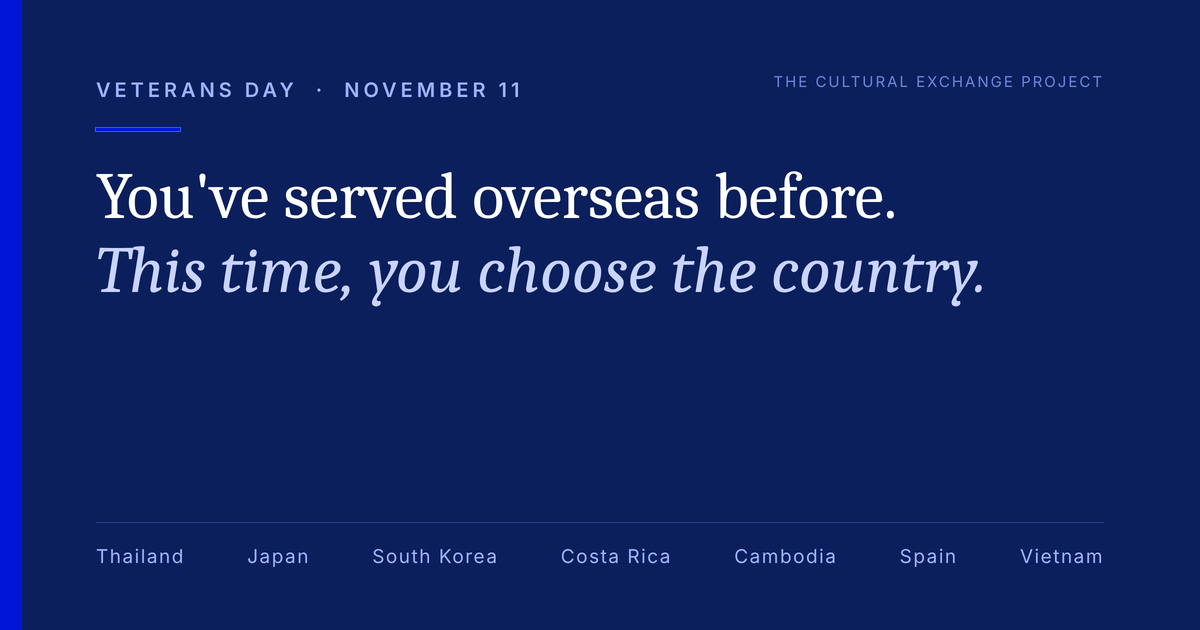
Nobody cuts your orders. You pick the country. We place teachers in Thailand, Japan, South Korea, Costa Rica, Cambodia, and Vietnam. If you were stationed in Japan or South Korea, you can go back and see the place from the other side of the fence.

You pick the length, too. Thailand's summer program runs 7 to 12 weeks. Other contracts run a semester, 6 months, or a full year. And you have a guaranteed teaching job before you get on the plane, so you aren't landing in a strange city to go looking for work.

And this time you live in the town. You rent an apartment. You buy breakfast from the same stall every morning, and in Thailand that meal costs about $3. Within a month, people know your name.

The pay is modest, and I'd rather you hear it from me now. Our own page says it in one line: enough to live comfortably, not luxuriously. In Thailand's summer program, that's $900 to $1,200 a month. In Vietnam it's $1,400 to $1,600. Nobody does this for the money. But rent is a fraction of what you pay at home. In Thailand it runs about $150 to $300 a month.

The questions you're carrying

"Am I too old for this?" Our teachers range from their early twenties to their fifties, and a big group is career-changers in their thirties. You won't be the only one in the room who has had another life first.

"How do I tell my family?" Start with the part they're afraid of. This is not a deployment. You'll have a U.S.-based program manager who knows your name, in-country staff on call 24 hours a day, and an emergency number that answers at 3 a.m. If it helps, bring your mother or your spouse onto the call with us. That conversation goes better when the person who's worried can ask their own questions.

"Do I need a degree?" It depends on the country. Thailand and Vietnam require a bachelor's degree. Each program page lists its own requirements, and we can tell you in one call which ones fit you.

"Can I use my GI Bill?" I can't answer that one for you, and I don't want to guess. The VA decides which certifications its benefits cover, and its GI Bill Comparison Tool is where you check. Look it up before you count on it either way.

Where to start

Start small. Take the three free TEFL Plus modules this week. You'll be 22% of the way to your certificate, and by the end of module three you'll know whether standing in front of a classroom is something you want to do again.

Then talk to us. One call. No pressure.

You've already proven you can go somewhere hard because someone asked you to. What would you do with a year abroad that you chose for yourself?

Talk with us about teaching abroad after your service

Frequently Asked Questions

Can military veterans teach English abroad?

Yes. Military veterans can teach English abroad in paid positions, and service history is not a barrier. The Cultural Exchange Project places native English speakers in guaranteed paid teaching jobs in Thailand, Japan, South Korea, Costa Rica, Cambodia, Spain, and Vietnam. Requirements such as a degree or TEFL certificate vary by country.

Can I use the GI Bill to pay for TEFL certification?

It depends on whether the VA has approved the specific course or certification. The VA's GI Bill Comparison Tool at VA.gov lists the schools, licenses, and certifications approved for GI Bill benefits. Check there, or ask the VA, before you count on benefits covering a TEFL course.

Am I too old to teach abroad after military service?

In most cases, no. Teachers with The Cultural Exchange Project range from their early twenties to their fifties, and many are career-changers in their thirties. Some countries have their own age rules for work visas, so the best step is a short call to check which programs fit you.

Do I need a college degree to teach English abroad?

It depends on the country. The Cultural Exchange Project's programs in Thailand and Vietnam require a bachelor's degree, and each country's program page lists its own requirement. Paid teaching positions also require a TEFL certificate, and the first three modules of CEP's TEFL Plus course are free.

Why is Veterans Day on November 11?

Veterans Day began as Armistice Day on November 11, 1919, the first anniversary of the end of World War I. According to the U.S. Census Bureau, there were 15.7 million veterans in the United States in 2024, or 5.9% of adults. About 1.7 million of them were women.


The Cultural Exchange Project is a 501(c)(3) nonprofit that has placed native English speakers in paid teaching positions abroad for decades. Programs are in Thailand, Japan, South Korea, Costa Rica, Cambodia, and Vietnam.

Randy LeGrant, CEP's Executive Director, writes these blog posts. If you like his writing, he also writes The Crossing — a weekly letter drawn from fifty years of watching people change their lives and their location. One story, one step, one question. Three minutes, every Friday. Subscribe for free here.

1 min read

Teach and Volunteer in Thailand - discover Bangkok traffic solutions

One of the joys of travel for me is to see how people move about cities -- we don't do it so well in my country, America. On our Volunteer and...
Read More
What Changed in Teach-Abroad This Quarter: A Q3 Recap

1 min read

What Changed in Teach-Abroad This Quarter: A Q3 Recap

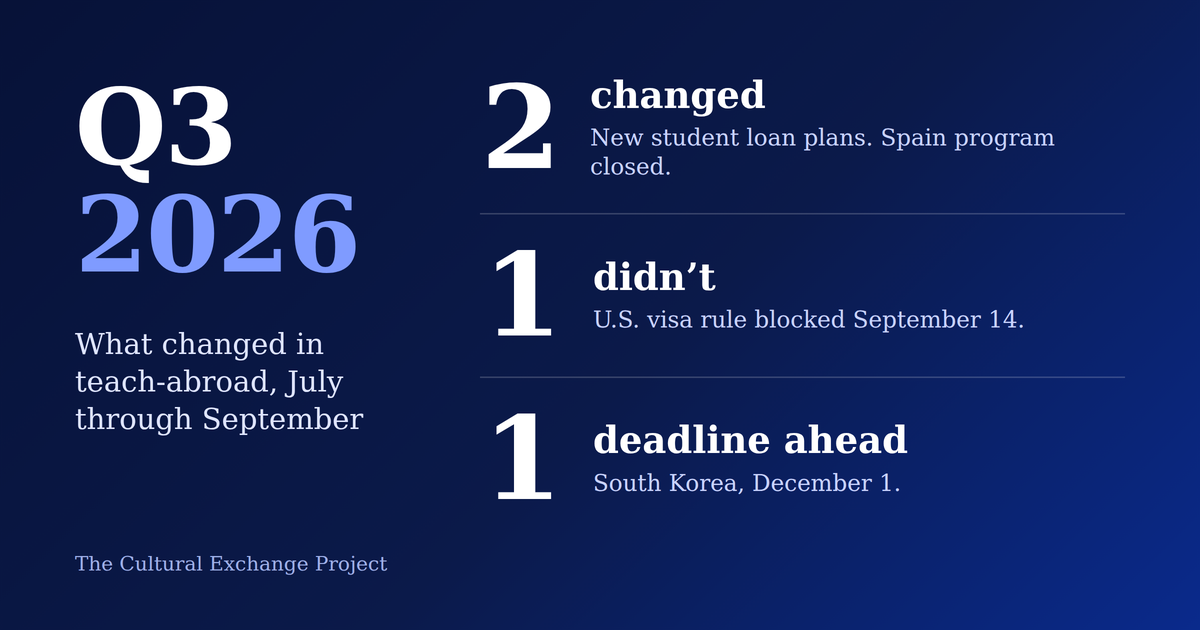
Current as of October 5, 2026. Court rulings, federal student loan rules, and application deadlines change. Confirm loan details at StudentAid.gov...

Read More
Teaching in Japan Next Year: The Application Timeline Starts Now

1 min read

Teaching in Japan Next Year: The Application Timeline Starts Now

Here is the thing almost no one tells you about teaching in Japan: the hardest part isn't getting hired. It's the paperwork clock that startsafter...

Read More
Susan Syracuse: I Teach Abroad My Way

1 min read

Susan Syracuse: I Teach Abroad My Way

In 2025, the Cultural Exchange Project decided to end our involvement with the homestay tutor program. Liability insurance costs and the...

Read More
Teacher Diversity Here And Abroad

1 min read

Teacher Diversity Here And Abroad

When I checked my email first thing this morning, I noticed an article from Education Week entitled How COVID-19 Is Hurting Teacher Diversity. I...

Read More
Teach English Abroad! Five Blogs That Help

1 min read

Teach English Abroad! Five Blogs That Help

On December 12, Edudemic ran a Blog post we really liked by Jeff Dunn, the Executive Director of Edudemic. They produce a monthly iPad magazine...

Read More