

5 min read

Cambodia vs. Thailand: Which Flexible-Start Program Fits You?

Cambodia vs. Thailand: Which Flexible-Start Program Fits You?
9:53

Current as of October 2026. Salaries, fees, and intake dates come from CEP's live Cambodia and Thailand program pages. Confirm them with your CEP advisor before you book a flight or give notice.

You have done the calendar math already. If I leave in January, I lose the year-end bonus. If I wait until June, my lease runs out in April, and I'll be sleeping on my sister's couch. If the program only starts once a year, that's eleven more months of telling myself next year.

Career-changers carry a different weight than a 22-year-old with a new diploma. You have a job to leave, a lease to break, and maybe a manager who will take it personally. Under it all is the worry about timing. Will the door still be open when you've untangled enough to walk through it?

Cambodia and Thailand are the two CEP programs built for that worry. Neither makes you wait for one annual intake. They are flexible in different ways, and the difference matters more than which country has the better beaches.How each program handles your start date

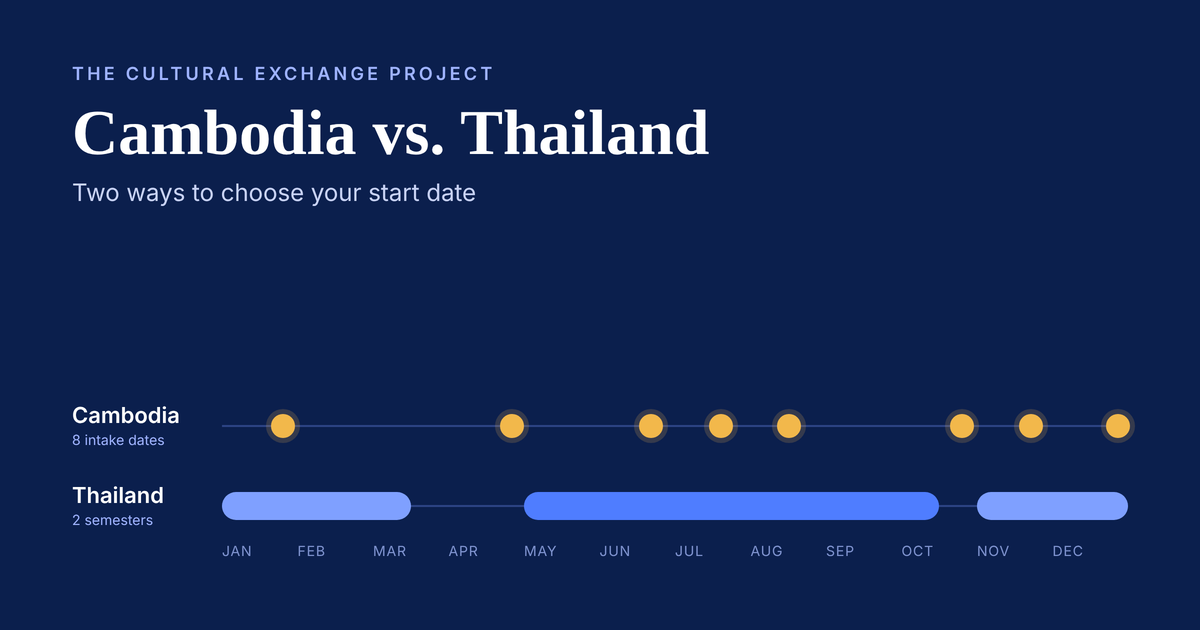
Cambodia runs on a fixed calendar with many intake dates. There are eight intake dates in 2027: January 25, April 26, June 21, July 19, August 16, October 25, November 22, and December 27. If one date doesn't work, the next is usually 4 to 8 weeks away. January and July are the best arrival months because they align with the start of the Cambodian semester. For the rest of 2026, the November 30 and December 28 intakes still show open places on the program page this week.

Thailand works the other way around. We don't list intake dates. You talk with our team, choose a semester or a full academic year, and settle the arrival date together. The Thai school year has two semesters, May to mid-October and November to mid-March, and most arrivals are in late April and late October. If you can't wait that long, you can arrive early and work as a substitute until the next term begins. Arrive in January, and you substitute until the April intake.

So, for a career-changer, the question is what kind of flexibility you need. Cambodia offers more fixed dates to aim for. Thailand lets you build the date around your life, inside the rhythm of two semesters.

The degree question settles it for some readers

Thailand requires a bachelor's degree. Cambodia does not.

If you went to work instead of college, learned a trade, or built a career on experience, Cambodia is the program that says yes. Degree holders earn more there, but the door is open either way.

Both programs require a 120-hour TEFL certificate. CEP bundles TEFL Plus, our 120-hour internationally accredited online course, into the Guaranteed Job Plus TEFL option for each country. Try the first three modules free before you decide.

What you earn, and what you keep

Thailand pays THB 45,000 a month, about $1,340 at October 2026 exchange rates. The school provides health insurance once your work permit is issued, and you earn a completion bonus when you finish your contract. The job includes 10 or more paid public holidays.

Cambodia pays $800 to $1,500 a month without a degree and $1,000 to $1,600 with one. You buy your own travel insurance for the contract length. Many teachers add private English tutoring on the side, and some double their income that way.

Now look at what each program expects you to save. CEP estimates $300 to $500 a month in Cambodia and $100 to $300 a month in Thailand.

The smaller paycheck saves more.

Daily life in Cambodia runs about $10 a day. A tuk-tuk ride costs $1, and a meal costs $3. Rent is $200 to $400 a month in Cambodia and $150 to $300 in Bangkok, so housing costs are similar. The gap comes from everything else.

Program fees run the other direction. The Thailand Guaranteed Job program costs $1,600, or $1,790 with TEFL Plus, and the page notes that the fee is held until early 2027. Cambodia is $2,090, or $2,280 with TEFL Plus, and it includes a full week of orientation with accommodation, cultural excursions, and Khmer language lessons. Thailand's orientation is three days in Bangkok, with accommodation and a practice teaching day.

Where you live and how your week runs

Thailand means Bangkok for about 95 percent of placements. You teach in public or private schools, mostly kindergarten through 8th grade, Monday to Friday with weekends off. Classes average 25 to 35 students. Thai homeroom teachers support you in the room, and they provide lesson plans. If you have spent fifteen years in an office, a structured week in one large city is a gentle landing.

Cambodia spreads teachers across Phnom Penh, Siem Reap, Battambang, Poipet, and Serei Saophoan. You state your preferences, but the location isn't guaranteed. Classes are smaller, 15 to 25 students. Private and international schools run Monday to Friday. Language schools run afternoons and full weekends, with two weekdays off. You will likely teach more than one subject in English. And Angkor Wat is a day trip from many placements.

Contract length is where the career-changer math comes back around. Cambodia contracts run 12 months, renewable. Thailand offers one semester (about five months) or a full year, and you can extend for more semesters at no extra cost. Of the career-changers CEP has enrolled, most chose a long-term program. People changing careers want enough time to see whether the new life holds. A five-month semester in Bangkok lets you find out without committing a full year. And if even five months feels like too much, our Thailand Summer program is shorter still.

Which one fits you

Choose Cambodia if you don't hold a degree, want the lowest cost of living CEP offers and the most dates to choose from, or prefer smaller classes and a full year abroad.

Choose Thailand if you hold a degree, if school-provided health insurance and a completion bonus matter to you, if you want one big city with a Monday-to-Friday week, or if you want to try a five-month semester before you commit to more.

In fifty years of this work, I have watched the calendar talk more people out of going than any fear of the classroom ever did. The calendar is almost never the real obstacle. Both programs have a date that fits a life in the middle of untangling.

So which date have you been using as the reason to wait?

Talk to us about teaching in Cambodia or Thailand

Frequently Asked Questions

Do I need a degree to teach English in Cambodia or Thailand?

Thailand requires a bachelor's degree for CEP's paid teaching program. Cambodia does not require a degree, though teachers with one are paid more: $1,000 to $1,600 a month compared with $800 to $1,500 without one. Both programs require a 120-hour accredited TEFL, TESOL, or CELTA certificate.

Which pays more for English teachers, Cambodia or Thailand?

Thailand pays more. CEP's Thailand program pays THB 45,000 a month (about $1,340 at October 2026 exchange rates), plus a completion bonus and school-provided health insurance once your work permit is issued. Cambodia pays $800 to $1,600 a month depending on whether you hold a degree. Because Cambodia's living costs are lower, CEP estimates Cambodia teachers save $300 to $500 a month compared with $100 to $300 in Thailand.

When can I start teaching English in Cambodia?

CEP's Cambodia program has eight intake dates in 2027: January 25, April 26, June 21, July 19, August 16, October 25, November 22, and December 27. January and July are the best arrival months because they align with the start of Cambodian semesters. Schools in Cambodia hire year-round, so the next intake is usually four to eight weeks away.

When can I start teaching English in Thailand?

CEP's Thailand program has no fixed intake list. You choose a semester or a full academic year and agree on an arrival date with CEP. The Thai school year runs May to mid-October and November to mid-March, with main arrivals in late April and late October, and teachers who arrive earlier can work as substitutes until the next term begins.

Do I need a TEFL certificate to teach in Cambodia and Thailand?

Yes. Both programs require a minimum 120-hour internationally accredited TEFL, TESOL, or CELTA certificate. CEP's TEFL Plus is a 120-hour accredited online course bundled into the Guaranteed Job Plus TEFL option, and the certificate is valid for life and works for any CEP country program: Thailand, Japan, South Korea, Costa Rica, Cambodia, and Vietnam. The first three modules are free to try.


The Cultural Exchange Project is a 501(c)(3) nonprofit that has placed native English speakers in paid teaching positions abroad for decades. It runs programs in Thailand, Japan, South Korea, Costa Rica, Cambodia, and Vietnam.

Randy LeGrant, CEP's Executive Director, writes these blog posts. If you like his writing, he also writes The Crossing — a weekly letter drawn from fifty years of watching people change their lives and their location. One story, one step, one question. Three minutes, every Friday. Subscribe free here.

Cambodia's Year-Round Start Dates: The Options Nobody Talks About

1 min read

Cambodia's Year-Round Start Dates: The Options Nobody Talks About

Program details and figures reflect our Cambodia program as of mid-2026 and can change. Confirm current intake dates and specifics with us before...

Read More
Teaching in Japan Next Year: The Application Timeline Starts Now

1 min read

Teaching in Japan Next Year: The Application Timeline Starts Now

Here is the thing almost no one tells you about teaching in Japan: the hardest part isn't getting hired. It's the paperwork clock that startsafter...

Read More
Your Degree Needs a Head Start for Thailand's November Term

1 min read

Your Degree Needs a Head Start for Thailand's November Term

Current as of August 2026. Semester 2 in Thailand runs November through mid-March, with arrival anytime in November. There's no fixed application...

Read More
What to Know Before You Get A Guaranteed Teaching Job Abroad

1 min read

What to Know Before You Get A Guaranteed Teaching Job Abroad

If you are tired of sending resumes without hearing back, a paid teach abroad program with guaranteed placement may offer a more direct path to...

Read More
Teach In Thailand--Our January 2012 Group Of Teachers

1 min read

Teach In Thailand--Our January 2012 Group Of Teachers

It all began on Sunday January 8th, 2012. The January intake group for GeoVisions' Teach in Thailand program met Kevin and Jaco in the lobby of the...

Read More
Why Thailand is One of the Best Countries to Teach English

1 min read

Why Thailand is One of the Best Countries to Teach English

Thailand has long been one of the world’s most popular destinations for teaching English, and it’s easy to see why. With stunning beaches, lush...

Read More