1 min read
Burned Out but Not Done: The Working Teacher's Guide to Going Abroad
There's a specific kind of tired that only teachers know. It isn't that you've stopped caring about the work — it's that the work around the work has...

4 min read
Randy LeGrant
:
August 31, 2026
We surveyed the last 25 people we sent abroad to teach English. Not 25 hypothetical people from a survey a marketing team ran somewhere. 25 teachers we can name who filled out an application, packed a bag, and got on a plane.
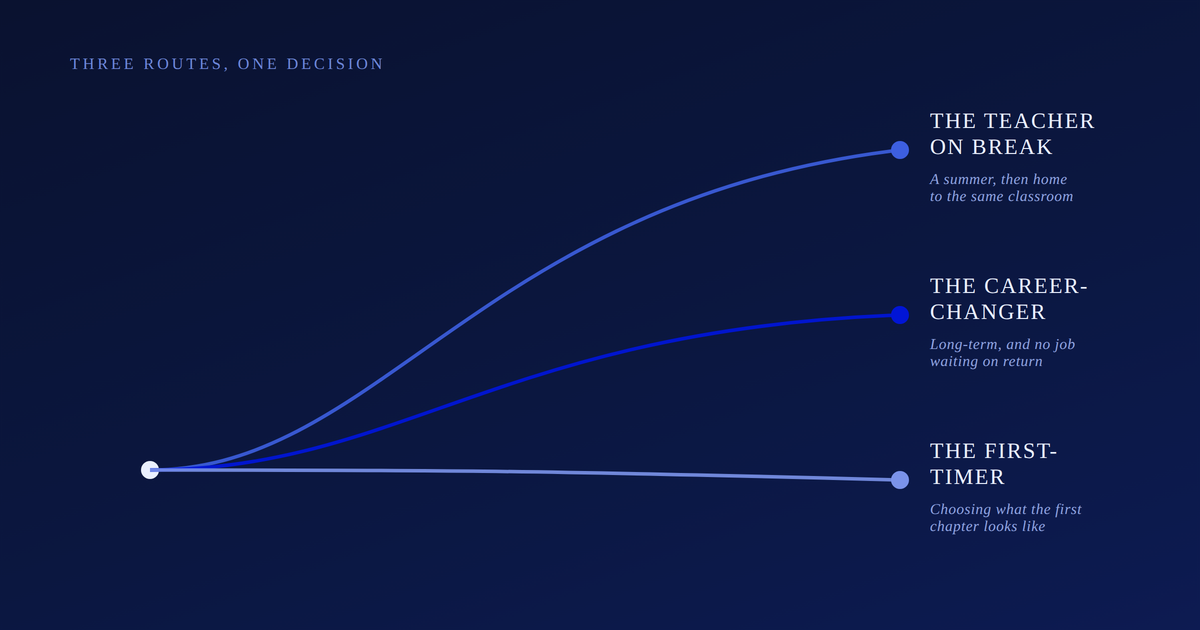
We looked at what they had in common before they left. Not much, it turns out. A 22-year-old with a diploma still warm from the printer has almost nothing in common with a 34-year-old who has been grading the same stack of quizzes for a decade. But look closer, and three shapes appear.
You are probably one of them. Here is how each one actually does this and what tends to trip them up.
9 of the 25 were already standing in a classroom when they applied, employed as teachers back home. A strong majority of that group did not quit anything. They took a summer.
7 to 12 weeks in Thailand during June, July, and August. The same job is waiting when they land back home in the fall. Same classroom, same principal, same September staff meeting. They used the summer the way another person might use it to renovate a kitchen. Something they had wanted done, something they could point to, but not something that reorders their whole life.
The plane home is the whole plan for this person, from day one. Nothing about the trip counts as commitment. It only counts as evidence, something they get to carry back into a classroom of their own, in a country where the closest thing to Thailand most of their students will ever see is a picture in a textbook.
They succeed by treating the summer like the professional development that the fall never budgets for them. The ones who struggle treat it like a vacation with worksheets and come home with photos instead of anything they can use on a Tuesday in October.
11 of the 25 were not teachers back home. Some worked in offices. Some had already quit something before they applied. The application itself was the second decision, not the first. A strong majority of this group did not choose a summer. They chose long-term, a semester or a full year, the kind of program that doesn't leave a job waiting on the other end, because there usually isn't one.
This is the harder jump. Not because the flight is longer. Because there is no plane home built into the plan, the way there is for the teacher on break. The decision has to hold weight on its own, months before departure, usually while a parent or a partner is asking some version of the same question at the dinner table. What happens after?
TEFL certification is usually the first real hurdle for this group, since most of them have never stood in front of a class of 30 children. TEFL Plus handles that. The first three modules are free, no card required, before anyone has to decide whether they are actually doing this.
They succeed by naming what they are changing before they leave, not after. The ones who struggle spend the flight over still deciding whether they made the right call, instead of deciding it on the ground before they ever booked the ticket.
The ages in this group cluster in the early twenties, right out of school or close to it, with no classroom of their own yet in either country. They are not on a break from a career. They have not changed one. They are choosing what the first one looks like before anyone else gets to choose it for them.
This is the group most likely to hear the loudest version of what happens after. A parent worried about safety. A friend asking why not just get a real job first? Thailand Summer accepts new graduates for exactly this reason, degree in hand, nothing yet built up around it to protect or unwind.
They succeed by treating this as the start of a resume rather than a break from one. Those who struggle wait for a version of themselves who feels ready, but that version does not show up before the deadline does.
No. 11 of the 25 teachers in our own program data had never taught before they applied, and a strong majority of that group chose a long-term placement rather than a short summer program. Programs in Costa Rica, Japan, South Korea, and Cambodia don't require prior teaching experience, and TEFL Plus covers the certification most career-changers need before their first day in a classroom.
Yes. CEP's Thailand Summer program runs for 7 to 12 weeks in June, July, and August, timed for teachers who want to travel and come home to the same classroom in the fall. Most current classroom teachers in our program chose this route rather than leaving their jobs.
That's true of a strong majority of CEP-placed teachers, and it isn't a disqualifier. Pre-departure materials and in-country orientation are part of every program, along with a US-based support team throughout your contract. The bigger predictor of success is deciding why you're going before you land, not how much you've traveled before.
It depends on the country. Thailand, Thailand Summer, Japan, South Korea, and Vietnam require a bachelor's degree. Costa Rica and Cambodia both accept qualified applicants without one. If you're a graduating senior, CEP can confirm your on-time graduation with your academic advisor and still process your application now.
Both, depending on which of the three groups you're in. Current classroom teachers in our data mostly used it as a break, choosing a summer program. Career-changers mostly used it as a starting point for something new, choosing a longer placement. Neither approach succeeds more than the other. What matters is picking the one that matches what you actually want when you land.
The Cultural Exchange Project is a 501(c)(3) nonprofit that has placed native English speakers in paid teaching positions abroad for decades. Programs in Thailand, Japan, South Korea, Costa Rica, Cambodia, and Vietnam.
Randy LeGrant, CEP's Executive Director, writes these blog posts. If you like his writing, he also writes The Crossing, a weekly letter drawn from fifty years of watching people change their lives and their location. One story, one step, one question. Three minutes, every Friday. Subscribe for free here.
1 min read
There's a specific kind of tired that only teachers know. It isn't that you've stopped caring about the work — it's that the work around the work has...

1 min read
Each week, GeoVisions will post an actual email from a Conversation Corps tutor, a Conversation Partner or a full time teacher abroad on a...
1 min read
Delicious Thai cuisine. Playful puppies. Exotic elephants. These are just some of the things you will experience while teaching English in Thailand. ...
1 min read
When I decided to come to teach in Thailand through GeoVisions, it took me 6 months to fill out the application. I always came up with an excuse...
1 min read
Due to the violence in Myanmar, we have suspended our Teach English in Myanmar program. It is not a permanent suspension. We want to ensure the...
1 min read
It all began on Sunday January 8th, 2012. The January intake group for GeoVisions' Teach in Thailand program met Kevin and Jaco in the lobby of the...